
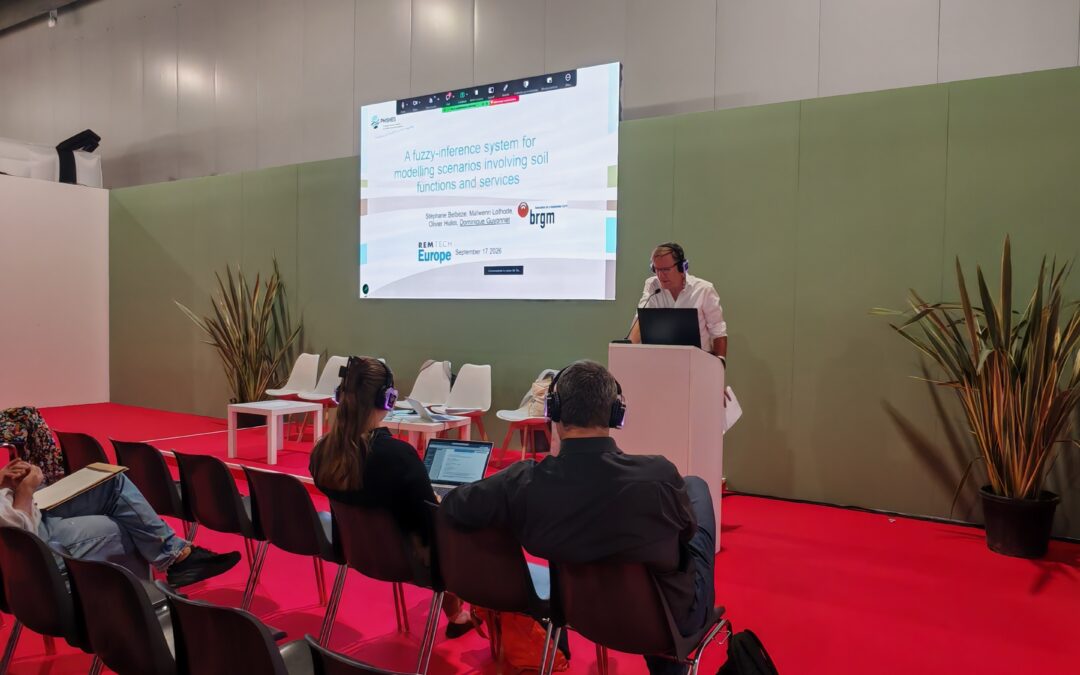
On 17 September 2026, PHISHES took part in RemTech Europe in Ferrara, Italy, organising the special session “From data on soil health to quantitative assessment of the effects of soil management practices on soil functions and associated ecosystem services.”
RemTech Europe provided an opportunity to bring the PHISHES approach into dialogue with researchers and practitioners working on soil contamination, remediation, soil functions, and sustainable management.
The session was chaired by Dominique Guyonnet (BRGM) and brought together contributions from PHISHES partners: Alexandra Murray (DHI), Project Coordinator; Prof. Bjarne W. Strobel (UCPH); Annemieke Marsmann (Deltares); Vaclav Rara (CzechGlobe); Hendrik Kok (Deltares); Andrzej Brandyk (SGGW); and Robert Earon (SGI). The discussion was further enriched by contributions from related research projects, including SOILPROM, represented by Prof. Jakub Hofman (RECETOX), and ISLANDR, represented by Nazare Couto (NOVA).
A central theme emerging from the session was the need to look beyond soil merely as a receptor of pollutants and consider its capacity to filter, buffer and mitigate their impacts. This perspective places soil functionality at the centre of soil health assessment. Physical, chemical and biological properties all contribute to determining how soils function, while biological indicators can help reveal changes occurring within the soil system. For example, microbial biomass and processes at lower trophic levels can provide information on substrate availability, turnover capacity and the transformation of organic pollutants.
This broader understanding is particularly relevant to PHISHES. Indeed, the project investigates soil functions and associated ecosystem services by considering their interaction with three interconnected dimensions: land use, contamination and climate change.
Another important discussion concerned scale. Soil processes occurring at a single field or local site can have consequences that extend far beyond that location. Their cumulative effects across a catchment can ultimately influence the quality of streams, lakes, groundwater and drinking-water reservoirs. River water quality, for example, can be considered an endpoint reflecting how effectively soils perform their filtering function across a landscape. At the same time, soils play an important role as a water storage and retention matrix, helping to retain freshwater within terrestrial ecosystems.
The discussion therefore highlighted the importance of connecting local assessments with larger spatial scales: a challenge that is central to PHISHES and its development of integrated modelling approaches.
A related discussion emerged from a question from the European Commission on why addressing pollution in a decision-making context is particularly challenging. Every contaminant has its own behaviour within the incredibly complex soil system, making detailed mechanistic models important for understanding and predicting its fate and impacts. However, the data and expertise required to set up such models for every contaminant, and location are not always available. This points to the need for harnessing the information provided by such models, combining it with expert knowledge, and accounting for epistemic uncertainty (on a particular contaminant, the soil system, etc).
Moreover, the session explored the relationship between soil health, soil functionality, and land-use decisions. Understanding the inherent capacity of soils to filter pollutants can help identify where this capacity may need to be protected, restored, or enhanced. In some circumstances, technological or biotechnological solutions can complement natural soil functions, for example through interventions targeting specific pollutants at contamination hotspots or measures applied to topsoils affected by diffuse pollution. Quantitative assessment is therefore essential, as decision-makers need evidence about how different management or remediation measures could affect soil functions and the ecosystem services they support.
Participation in RemTech was part of the project’s scientific dissemination activities, aimed at connecting PHISHES results with expert and professional communities working on contaminated soils and remediation. These exchanges are particularly valuable as PHISHES moves into the second half of the project and progresses from developing its modelling methodology towards demonstrating how it can support practical applications and evidence-informed soil management.