
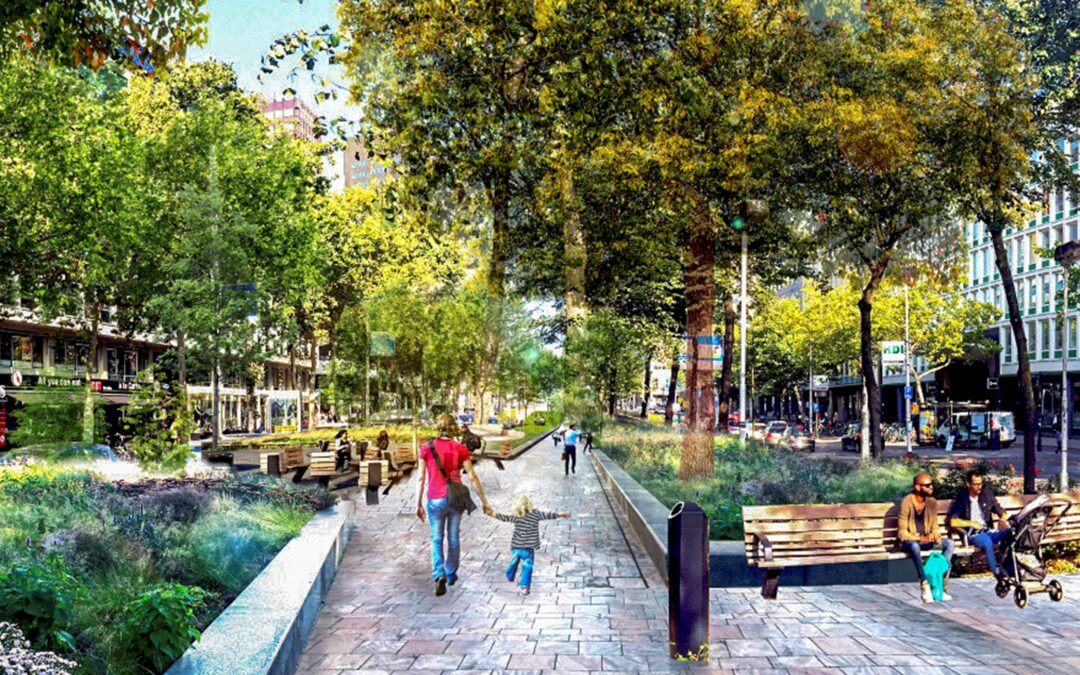
New activities at the Rotterdam Urban Area test site are helping PHISHES improve the assessment of nature-based solutions and their implications for soil health, groundwater processes and urban water management in densely urbanised environments.
Located in the Rhine-Meuse delta, the Rotterdam area is characterised by complex interactions between groundwater, surface water, urban infrastructure and land use, while also facing increasing pressures linked to climate change, biodiversity loss, and urbanization. Within PHISHES, the site provides a real-life test case for evaluating how urban adaptation measures may influence groundwater recharge, contaminant transport, soil functions and ecosystem services.
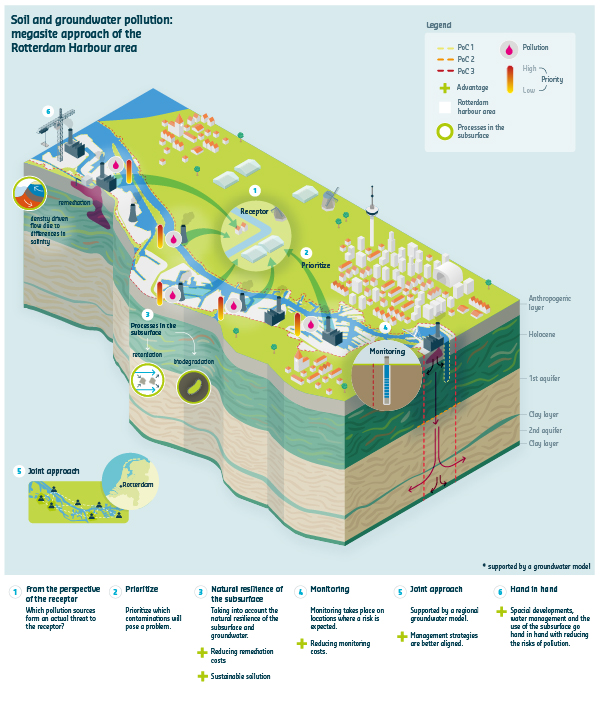
Location of Rotterdam in the Netherlands (bottom left) and cross section of harbour and urban area.
The Municipality of Rotterdam is already implementing several climate adaptation measures at neighbourhood scale, including underground urban water buffers, green-blue schoolyards and bioswales. These measures are now being included in modelling activities aimed at supporting more sustainable urban soil and water management strategies.
Building the modelling framework
Recent activities have focused on extending the existing modelling workflow with additional functionalities for simulating contaminant transport using groundwater transport models within the MODFLOW 6 framework. The workflow considers both transport processes in the unsaturated zone and groundwater transport in the saturated zone, supporting a more integrated assessment of groundwater flow and contaminant dynamics.
A first technical validation of the workflow has already been completed. Preliminary results indicate continuous transport from the unsaturated zone toward the saturated groundwater system and fixed boundary conditions. Additional work has focused on improving the integration between environmental datasets, modelling approaches and scenario analyses.
Next steps for urban climate adaptation scenarios
The next phase of activities will focus on further technical validation of the modelling workflow using standardised reference test models, followed at a later stage by validation with field measurements.
In collaboration with the Municipality of Rotterdam, researchers will also develop an initial set of scenarios to evaluate urban infiltration measures under future climatological conditions and urbanisation trends. Specific local test sites will then be selected to assess the effects of these measures using the integrated modelling framework developed within PHISHES.